How to date your vintage or current Anglepoise lamp
Posted on
December 9, 2025
Estimated Reading Time
10m
If you have an Anglepoise in front of you, there is a good chance it has already lived several different lives. It may have started on an engineer’s bench, moved to a draughtsman’s desk and eventually ended up next to a favourite chair. This guide is designed to help you date your vintage or current Anglepoise lamp and where possible point you towards the right spares, repairs and current collections.
Use it as a visual checklist. Start at the base, move up through the fork, springs and arms, then look closely at the shade and switch. The combination of those details usually reveals the model and the era. Once you have a likely match, you can cross reference it with our spares pages and current products.
Before you start: repairs, spares and safety
Many earlier Anglepoise lamps are still in daily use. That is something we are proud of, but it does mean you should treat rewiring and repairs with care. Older lamps were not designed around modern safety standards or bulbs.
If you plan to use a vintage Anglepoise every day, consider the following:
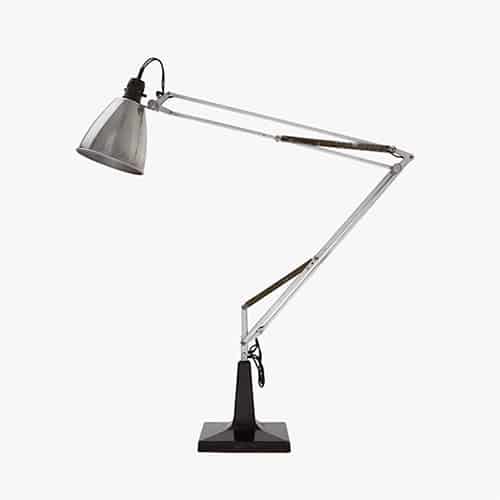
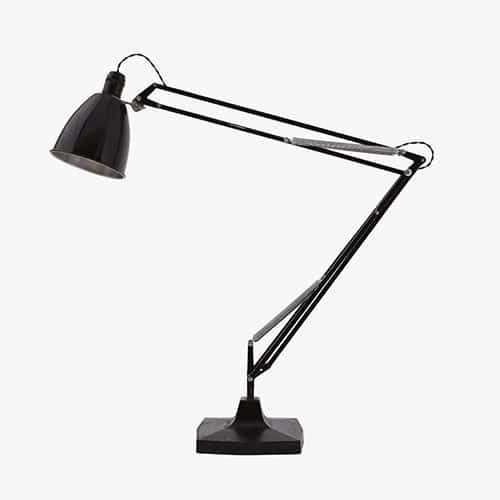
This is one of the earliest Anglepoise lamps and feels close to a working prototype. If your lamp has a tall, heavy cast base painted black, very simple springs and a slightly experimental look, you may be looking at a 1208.
The side arms are made from thin flat steel strips, while the other arms are aluminium. The springs are plain, without decorative caps or adjusters. Everything feels functional and engineered.
If you have one of these, a professional rewire is strongly recommended. You can support that with an electrical rewire kit and, if the shade has suffered over time, a newly tooled replacement shade based on the original 1932 design. On your site, link those phrases to your rewire kits, repair service and 1932 replacement shade product page.
Model 1208 / 1209 (around 1933–1968)
The Model 1208 / 1209 is the next step from the prototype and ran for a remarkably long time.
Compared to the prototype, the base is shorter and more compact. On many examples the side arms are round tubes rather than flat strips. Over the years the metal used for the arms varies. Early lamps might be brass, later versions steel or aluminium depending on what was available at the time. The shade is slightly larger and looks more like a finished product than an experiment.
As with the 1208, you should assume the wiring is now past its intended lifespan. This is a good moment to bring in an Anglepoise electrical rewire kit or book a repair. The 1932-style replacement shade is often the closest match if you need to replace a dented or rusted original.
The first icon: early and later Model 1227
Early Model 1227 (around 1935–1938)
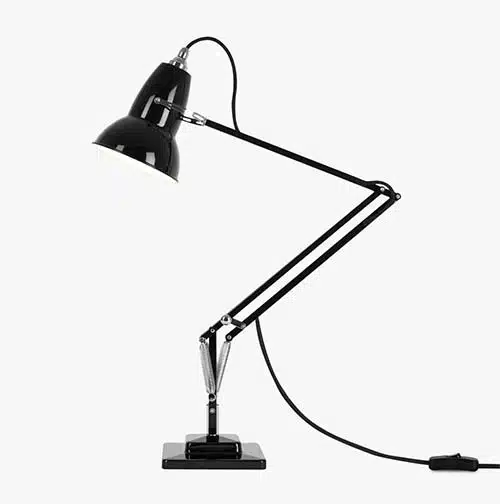
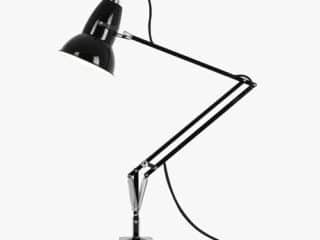
For many people, this is the classic Anglepoise silhouette.
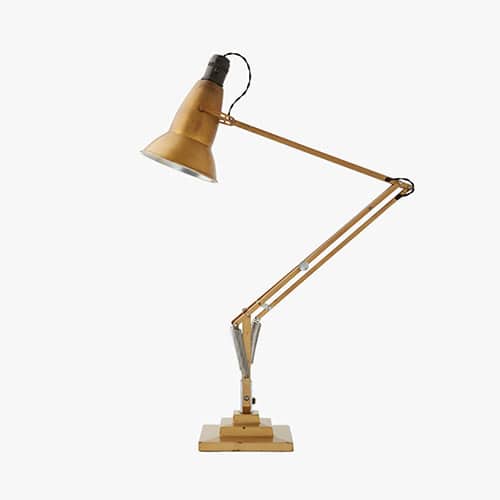
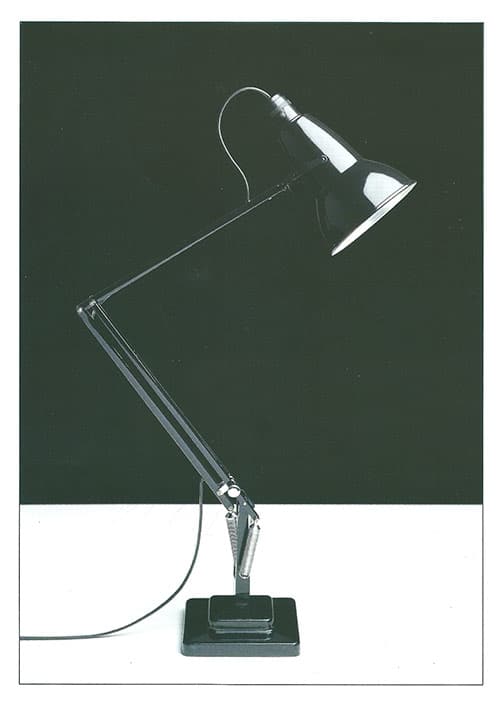
Early 1227 lamps have a solid three-tier painted base. The fork is built from separate components, with a central block that is often chrome plated. On the front of this block you will usually see “The Anglepoise – Made by Herbert Terry & Sons”. There is a visible earthing point on the back of the fork block.
Two spring bars are used, with the centre spring mounted higher than the outer pair. The position of the springs can be adjusted using different holes in the fork to change the tension. The arms tend to be steel with a sharp, square section and there is a small adjuster knob halfway up the rear arms.
The shade is thin and elegant, with two distinct curves. Look for small perforated holes around the top sides of the shade for cooling, and more perforations on the very top near the Crabtree switch.
On the blog you can cross link this section to the current Original 1227 collection, which carries the same design DNA into the present.
Later Model 1227 (around 1938–1968)
From the late 1930s onwards, the 1227 evolves but remains instantly recognisable.
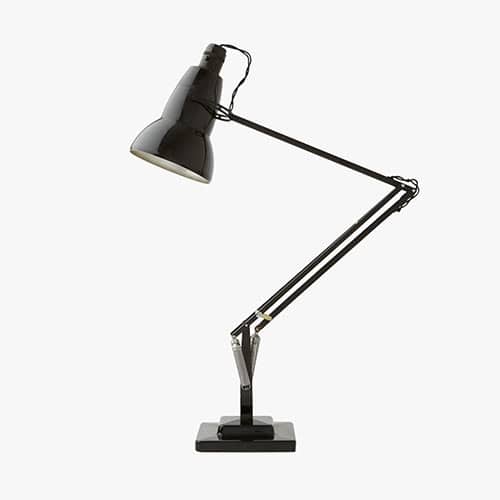
Later lamps use a two-tier base with a steel cover rather than the earlier solid painted base. The fork is now cast as a single piece with “The Anglepoise. Made by Herbert Terry & Sons” cast in. Springs often gain metal caps that allow fine adjustment of the spring length and tension. Over time the steel linkage strips and spacers at the base are gradually replaced with nylon components.
The shade grows a little wider. Ventilation slots move to the top only, rather than around the sides. Some earlier shades have a rolled-out edge at the bottom, while later ones have a simpler, straight edge.
For these lamps, you can guide readers towards Original 1227 spares and the current Original 1227 desk and floor collections as the modern equivalents.
Late 1960s and 1970s: small bases and fluted shades
Model 75 (around 1968–1973)
Model 75 is compact and neat, designed to take up very little space on a desk.
The base is round with a relatively small footprint. The fork has a softer, rounded profile and includes an oval recess stamped “Anglepoise”. Spring caps are often still present for adjustment and nylon components begin to appear in the linkage area. The side arms are tubular rather than flat strips and the swivel joint into the shade is metal.
The shade is distinctive and fluted, without a rolled edge at the bottom and usually painted white inside. The top section has a removable cap that allows access for maintenance, with a rocker switch built in.
For something slightly more contemporary there is the Type 75 Collection
Model 90 (around 1973–1985)
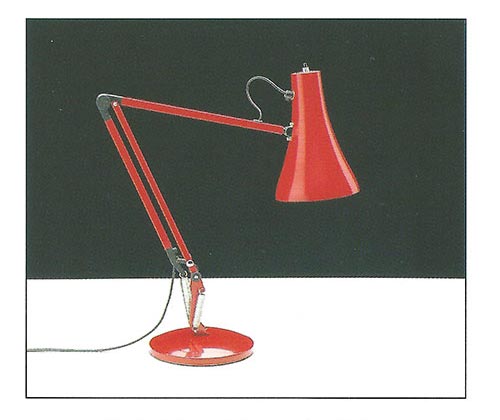
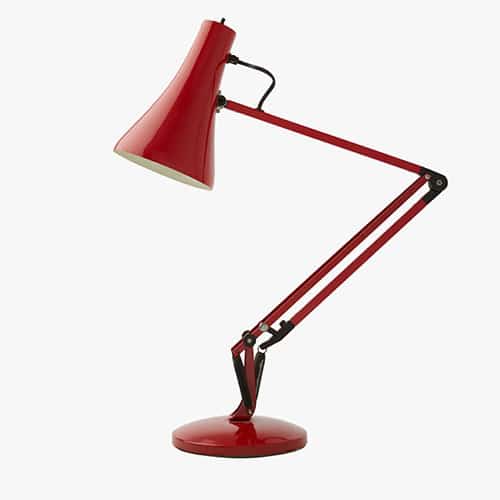
The Model 90 continues the compact approach, with a small footprint base and steel cover, but the engineering becomes simpler.
The fork is now a single bent steel strip fixed by a visible nut and bolt at the pivot. Springs are plain, without metal caps. The linkage strip is nylon, and the back arm includes a small nylon section where it meets the centre joint. Side arms return to flat steel strip and the top swivel has a nylon centre.
The shade remains fluted, but now uses a push-button switch on the top.
For a slightly smaller, playful and refined version of a similar looking lamp you can look at the 90 mini mini collection. Which comes in a range of different colours.
1970s and 1980s: four springs, goosenecks and fluorescent light
Model 82 (around 1975–2000)
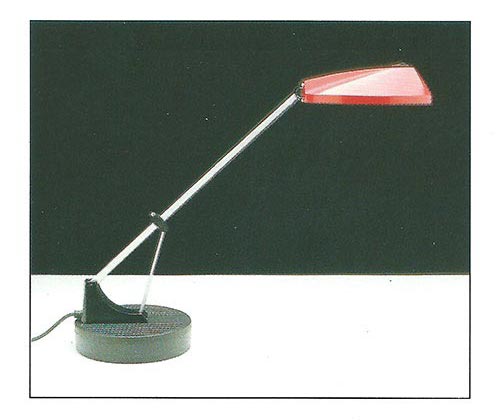
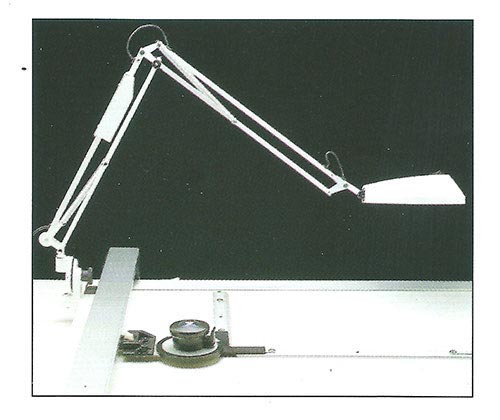
If your lamp has four springs rather than three, it may be a Model 82. This is a more industrial-looking mechanism and remained in production for a long time, so you may see variations. In some later marketing material it is referred to as the Radia 82.
Model 99 (around 1978–1995)
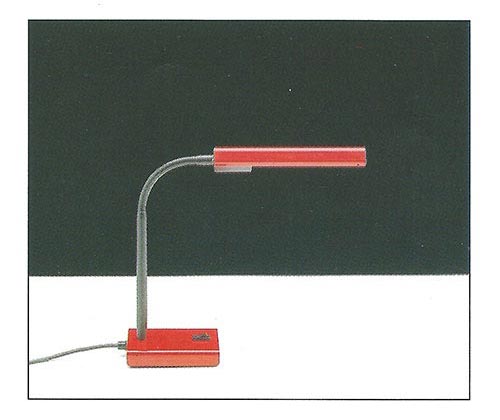
The 99 series is easy to recognise. It has a pressed square base and uses a gooseneck arm, sometimes described as a “stayput tube”. The flexible tube replaces the usual articulated arms and allows the shade to be pushed into position in one smooth movement.
Model 433T (around 1982–1992)
The 433T is a development of an earlier 433 lamp, adapted to use a 2D fluorescent bulb. The key giveaway is the increased base height, which houses the choke required for the fluorescent gear.
Model 82T (around 1982–1992)
The 82T shares the same shade as the 433T but hides the control gear in the back arm rather than in the base. If your lamp has a slightly bulkier back arm and a more slender base, it may well be an 82T.
For these fluorescent models, you can suggest modern LED bulb alternatives and encourage readers to seek professional advice if they want to keep the lamp in regular use.
Mid 1980s to late 1990s: Apex 90 and PL variants
Apex 90 (around 1985–2003)
The Apex 90 sits on a low-profile base with a larger footprint, finished with a steel cover. The fork is offset and made from bent metal strip, and the springs are often painted black.
At the junction between fork and side arms you will see plastic adjuster wheels on both sides. The tubular arms are relatively large in section and slot into plastic joints. The centre joint encloses the cable and is held with a screw.
The fluted shade is painted white inside. On top there is a push-button switch held in place by a smooth metal nut.
The 99PL uses an 11 Watt PL fluorescent bulb and requires a plug-in ballast. It shares the same arm system as the Apex 90 but uses different springs to balance the extra weight of the shade and control gear.
90PL (around 1985–1997)
The 90PL follows a similar formula, again using an 11 Watt PL bulb and plug-in ballast, with arms based on the Apex 90 system.
90LV (around 1985–1997)
The 90LV uses a 12 volt halogen bulb instead of a PL lamp. It requires a plug-in transformer to step down the voltage and again uses the Apex 90 arm system with springs tuned for the different load.
98PL (around 1987–1997)
The 98PL also takes an 11 Watt PL bulb and plug-in ballast but introduces a new friction joint mechanism. If your lamp feels smoother and more damped when you move it, with less “springiness” than a classic Anglepoise, it may be a 98PL.
1990s: reissues and experimental mechanisms
1227 Reissue (around 1993–1996)
In the early 1990s, Anglepoise reissued the Original 1227 to celebrate 60 years of the design.
These lamps have adjustable springs to cope with different bulb weights. The base cover is plastic and most examples were made in black, with a small number in Gunmetal. The switch is located in the lamp holder and operated by a plastic slider bar that activates an internal rocker switch.
For readers who like the look but want a lamp designed to current standards, you can link this section to the modern Original 1227 collection.
Artikula (around 1995–1999)
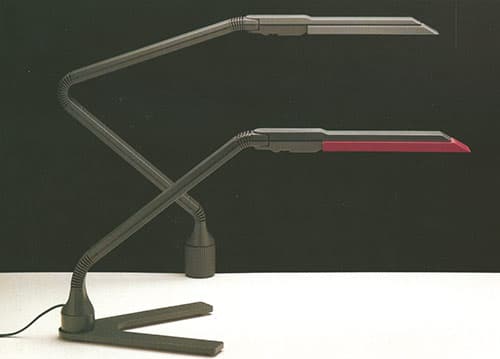
Artikula looks very different from a classic Anglepoise.
It uses a patented arm system based on the human spine, with a series of linked segments rather than exposed springs. The lamp was produced as both a desk and a table clamp version. If your lamp resembles a series of stacked vertebrae more than a spring arm, it is likely to be Artikula.
2000s onwards: the Sir Kenneth Grange era
From the early 2000s, industrial designer Sir Kenneth Grange reshapes the Anglepoise family.
Type 3 (around 2003–2007)
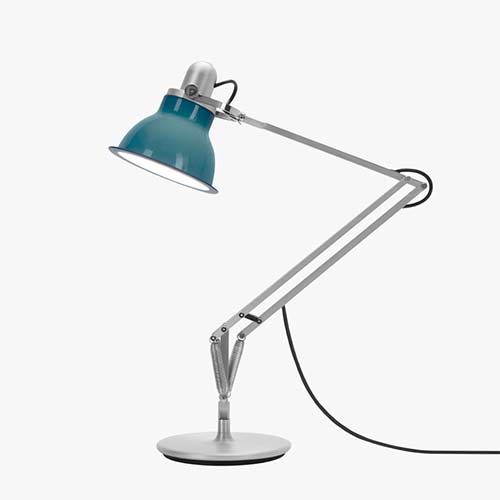
Type 3 is his first desk lamp for Anglepoise.
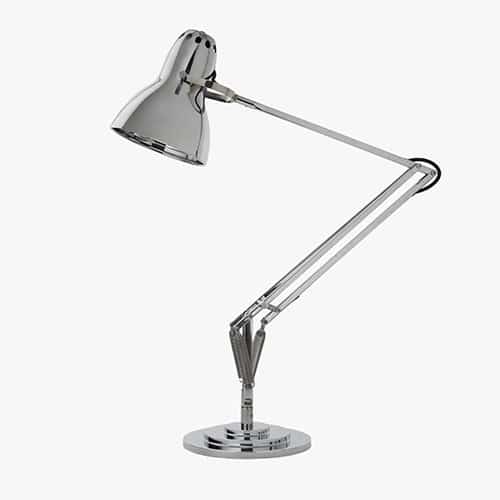
It stands on a solid steel three-tier base, often chrome plated. The die-cast zinc fork has a vertical recessed lozenge on the front for a logo plate. The springs use specially designed adjuster caps to fine-tune tension.
All the linkage strips are metal, held together with hex nuts and bolts. The arms are brass, polished and then chrome plated. Adjuster knobs are machined from steel and fitted with an o-ring for better grip.
The top arm transitions from square to round with a neat swaged detail where it meets the bridle. The bridle includes a solid stainless-steel section for rigidity.
The shade is aluminium with a smoothed double profile and distinctive vents at the top, often chrome plated, with a round black rocker switch. Inside there is an aluminium inner reflector.
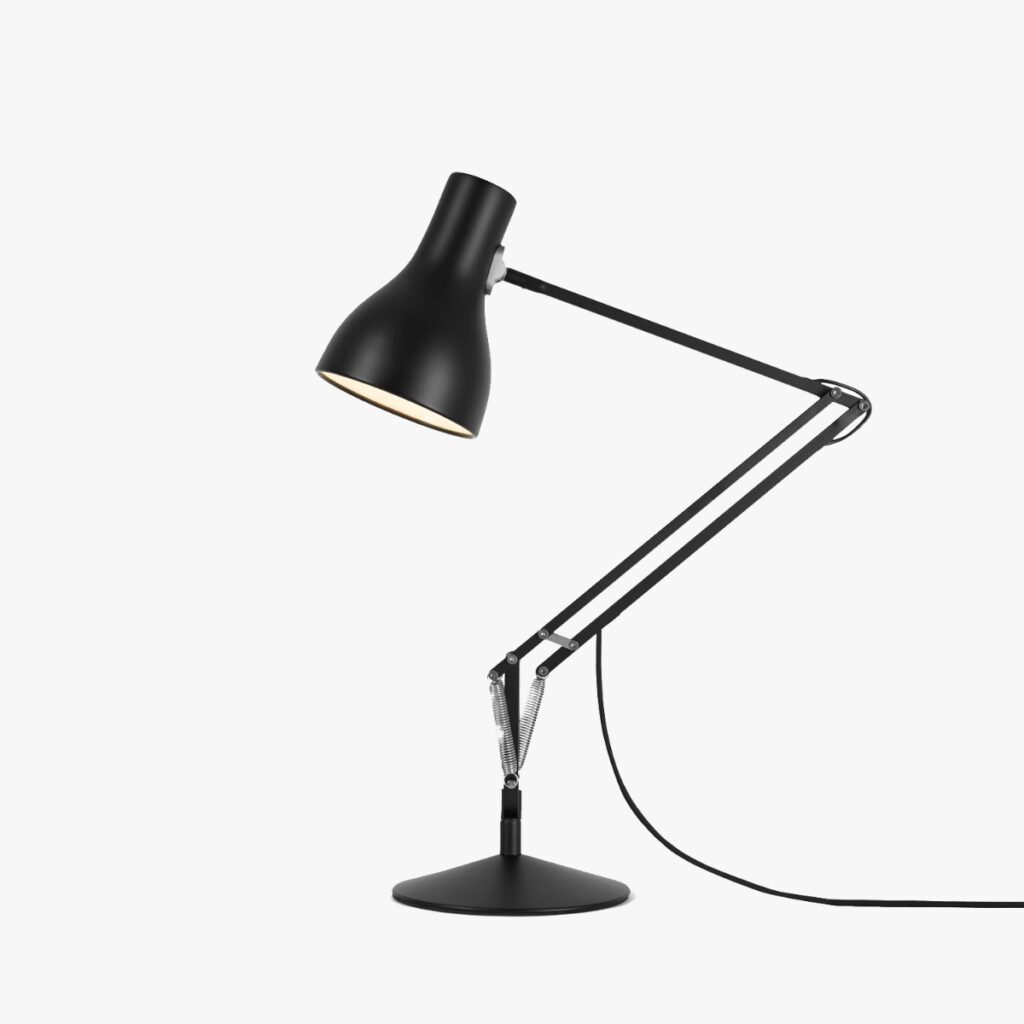
Type 75 is the second Sir Kenneth Grange desk lamp and has become a modern classic.
The design references the earlier Model 75 but simplifies it into a calm, modernist form. For many years the lamp featured an inline switch on the cable. In 2020 it was updated to a version with a shade-mounted switch, which is what you will find in the current Type 75 collection.
Type 1228 is the third Sir Kenneth Grange desk lamp.
It is easy to recognise by its polycarbonate shade, which gives a semi-translucent glow when lit while still providing focused task light. The lamp uses a special switched lamp holder cap.
Contemporary classics and miniatures
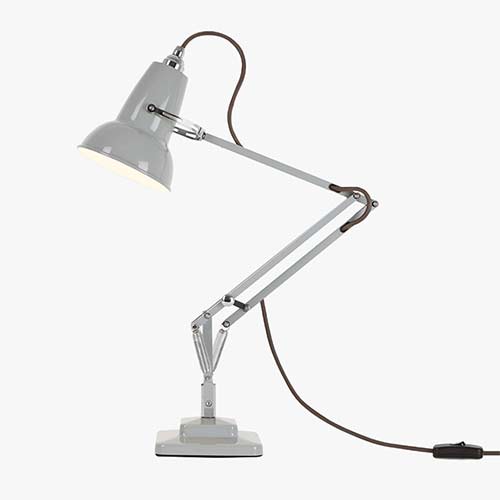
Original 1227 (2009–current)
In 2009, Anglepoise introduced a new interpretation of the Original 1227, designed for modern homes and workspaces while preserving the essential character of the original.
This version features an inline switch and sits within our current “Guaranteed for Life” offer on qualifying products. You can guide readers towards Original 1227 desk, floor and wall models, as well as the dedicated spares section.
Type C (around 2011–2014)
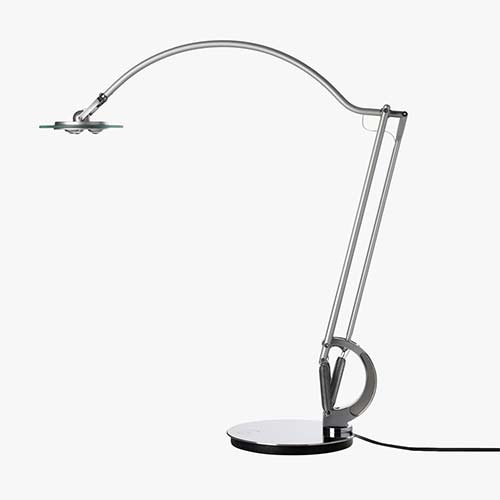
Type C is the fourth Sir Kenneth Grange desk lamp and one of our first to use fully integrated LED technology.
Because the LED is built in, the shade can be smaller and the overall form is more slender, with a curved top arm and fork. If the lamp looks more like a slim, continuous line of metal with a compact head, it may be a Type C.
Type 75 Mini (around 2011–current)
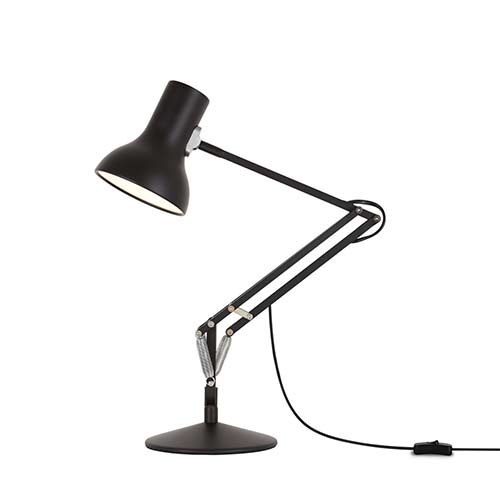
Type 75 Mini is a scaled-down version of Type 75.
Early versions have an inline switch on the cable, while later models move the switch to the shade, in line with the full-size Type 75 update. For those who would like spares or who wish to add another lamp to their collection there is the current Type 75 Mini collection.
Original 1227 Mini (2015–current)
Original 1227 Mini takes the much-loved Original 1227 form and reduces it to a smaller footprint. It retains an inline switch and works well on narrower shelves, bedside tables and smaller desks.
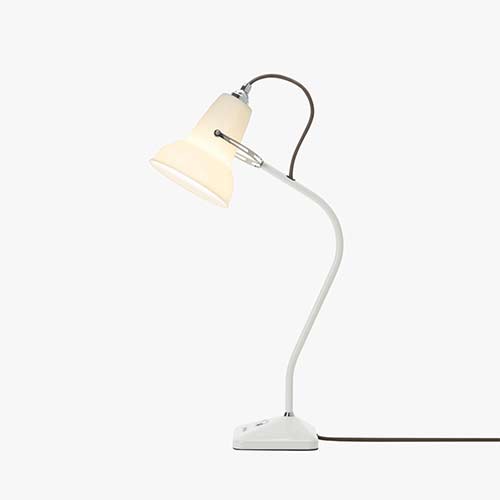
Original 1227 Mini Ceramic Table (2017–current)
This lamp uses the same compact format but introduces a translucent ceramic shade and a simpler structure.
Instead of a strong task beam, the 1227 Mini Ceramic Table produces a softer ambient glow. The switch is positioned in the base, so the lamp feels more like a small illuminated object than a traditional task light.
Newest generations: 90 Mini Mini and Type 80
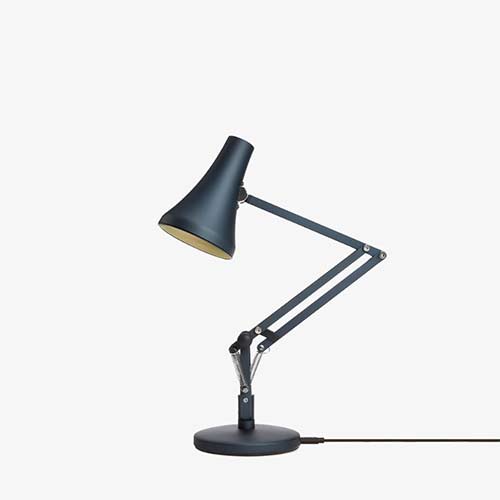
90 Mini Mini (2018–current)
90 Mini Mini is a playful reimagining of the Model 90, dramatically reduced in size.
It uses an integrated LED light source powered by USB and offers dimmable light. The base is tiny, the arm is short and the fluted shade immediately recalls the model 90 in miniature. You can find spares for this collection
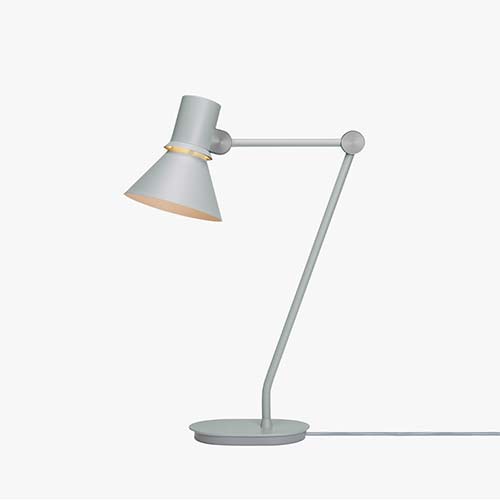
Type 80 (2019–current)
Type 80 is the sixth Sir Kenneth Grange desk lamp in the Anglepoise family.
Instead of visible springs, it uses a spring-based friction joint system hidden within the structure, giving very smooth movement and a cleaner outline. The metal shade includes a characteristic circular light spill feature that creates a halo of light on the outside of the shade as well as a focused pool of light below.
We hope that you find what you are looking for. We are aware that a guide like this cant cover everything, and we are also finding out new things out about our history and vintage products every day. If you would like to know more then please contact us.
Share
Related articles
13/01/26 / News
The latest launch of Scenery Magazine
09/12/25 / Guides
How to date your vintage or current Anglepoise lamp
14/09/25 / News
Two British icons. One giant celebration. Penguin books | Anglepoise